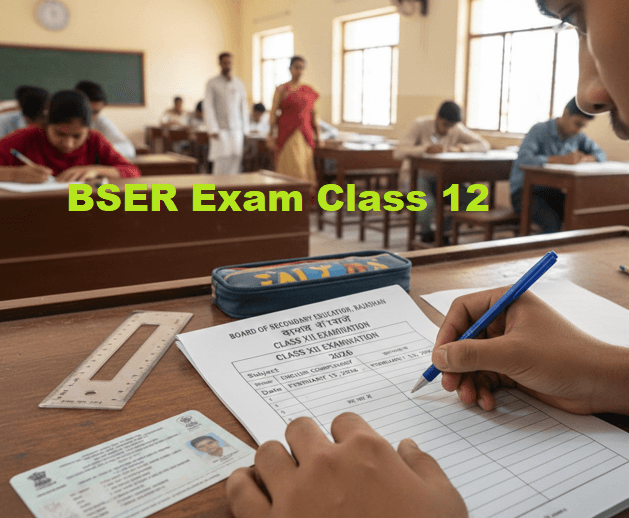
The BSER (Board of Secondary Education, Rajasthan), also known as RBSE or Rajasthan Board, conducts the Class 12 (Senior Secondary) examinations annually for students in Rajasthan. These exams are a crucial milestone, serving as a gateway to higher education (undergraduate courses, competitive exams like NEET, JEE, CUET, etc.), government jobs, and professional fields. As of February 2026, the RBSE Class 12 exams 2026 are currently underway (theory exams running from February 12 to March 11, 2026), marking a significant event for lakhs of students across the state.
This detailed description covers every aspect of the RBSE Class 12 exams, including history, structure, subjects, pattern, syllabus, preparation strategies, evaluation, results, and more—aiming for a comprehensive overview of approximately 4000 words.
1. Introduction to BSER and Class 12 Examinations
The Board of Secondary Education, Rajasthan (BSER), headquartered in Ajmer, was established in 1957 under the Rajasthan Secondary Education Act. It is one of India’s largest state boards, overseeing secondary (Class 10) and senior secondary (Class 12) education for affiliated schools (government, aided, and private) across Rajasthan. The board’s official website is rajeduboard.rajasthan.gov.in, where all notifications, syllabi, model papers, time tables, admit cards, and results are published.
The Class 12 examination, officially termed the Senior Secondary Examination, is held once a year (main exams in February–March, with supplementary/compartment exams usually in July). In 2026, over 8–10 lakh students (exact figures vary yearly) are appearing, reflecting the board’s massive scale. The exams follow a pen-and-paper mode (offline), with objective, short-answer, and long-answer questions to test conceptual understanding, application, and analytical skills.
Passing the RBSE Class 12 exam requires a minimum of 33% aggregate marks in each subject (including theory + practical/internal), with no negative marking. The board promotes holistic assessment through theory (major weightage), practicals (for science subjects), and internal/sessional assessments (20 marks in most cases).
2. Streams and Subject Combinations in RBSE Class 12
RBSE Class 12 offers three main streams, allowing flexibility in subject choices:
- Science Stream — Popular for engineering/medical aspirants. Compulsory: English, Hindi (or regional language). Core: Physics, Chemistry, Mathematics/Biology. Optional: Computer Science, Informatics Practices, Physical Education, etc.
- Commerce Stream — For business, finance, and accounting careers. Compulsory: English, Hindi. Core: Accountancy, Business Studies, Economics. Optional: Mathematics, Informatics Practices, Entrepreneurship.
- Arts/Humanities Stream — For civil services, law, humanities, journalism. Compulsory: English, Hindi. Core: History, Political Science, Geography, Economics/Sociology/Psychology. Optional: Home Science, Public Administration, Drawing, etc.
Vocational subjects (e.g., Agriculture, IT, Healthcare) are also available for skill-based education.
Total subjects: Students typically take 5–6 subjects (including languages). English and Hindi are compulsory in most cases.
3. RBSE Class 12 Exam Pattern 2026
The board revised the pattern slightly for 2025–26 to align with NEP 2020 principles (more competency-based questions, reduced rote learning).
General Structure (Most Subjects):
- Total Marks per Subject: 100.
- Theory Paper: 80 marks (3 hours 15 minutes duration).
- Internal Assessment/Sessional: 20 marks (class tests, projects, attendance, behavior, assignments).
- Science Subjects with Practicals (Physics, Chemistry, Biology, Geography, Home Science, Psychology): Theory: 56 marks. Practical: 30 marks. Sessional/Internal: 14 marks.
Question Types (Typical Breakdown for 80-mark Theory Paper):
- Multiple Choice/Objective Questions (MCQs): 10–20 marks (1 mark each).
- Very Short Answer (1–2 marks): 10–15 marks.
- Short Answer (3–4 marks): 20–30 marks.
- Long Answer/Essay Type (5–8 marks): 20–30 marks.
- Case-based/Application-based: Increasing emphasis (10–15 marks).
No negative marking. Questions test knowledge, understanding, application, analysis, and evaluation (Bloom’s taxonomy levels).
Duration and Timing (2026 Exams):
- Single shift: 8:30 AM to 11:45 AM (most papers).
- Some revised timings (e.g., Feb 17 & 24 papers shifted to evening 2:00 PM–5:15 PM due to center capacity issues).
Number of Questions: Usually 25–35 total, with internal choices in long-answer sections.
4. Detailed Subject-Wise Exam Pattern and Marking Scheme (2026)
- English (Compulsory, Code 02): Theory 80 + Internal 20 = 100. Sections: Reading (15), Writing (14–18), Grammar (8–10), Literature (Flamingo + Vistas: 35–40). Unseen passages, essay/letter writing, grammar application, textbook extracts.
- Hindi (Compulsory, Code 01): Similar 80+20. Aroh Part 2 (prose/poetry), Vitan Part 2, creative writing, grammar (alankar, shabd shakti).
- Physics/Chemistry/Biology: Theory 56 + Practical 30 + Sessional 14. MCQs, numericals, derivations, diagrams, experiments.
- Mathematics: 80 theory + 20 internal. Units: Calculus (high weightage), Algebra, Vectors/3D, Probability.
- Accountancy/Business Studies/Economics: 80+20. Numerical problems, case studies, theory questions.
- History/Political Science/Geography: Map work, long answers on events/policies, data interpretation.
The board released model papers and blueprints in December 2025 on rajeduboard.rajasthan.gov.in for practice.
5. Syllabus Overview (2025–2026 Session)
The syllabus follows NCERT textbooks in most subjects (especially Science, English). Key changes: Reduced syllabus in some areas post-COVID, more focus on application.
- Download full syllabus PDF from official site (e.g., Hindi/English detailed in board’s anudeshika-etc/12_2026.pdf).
- Important: Check chapter-wise weightage (e.g., Physics – Electrostatics 8–10 marks; Chemistry – Organic 20+ marks).
6. Time Table and Schedule for 2026 Exams
- Practical Exams: January 9 – February 8, 2026 (internal/school-level for non-science; external for science).
- Theory Exams: February 12 – March 11, 2026.
- English started on Feb 13, 2026 (morning shift).
- Revised timings for select dates due to high enrollment (over 6193 centers).
Admit cards released February 2–6, 2026 (school login on official portal).
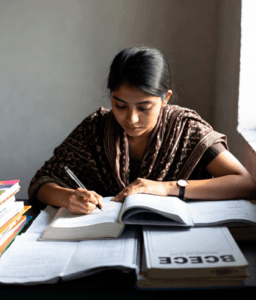
7. Preparation Strategies and Tips
- Study Plan: Cover syllabus by December; January for revision + mocks.
- Resources: NCERT books, RBSE model papers 2026, previous 5–10 years’ papers.
- Practice: Solve at least 10–15 model papers timed.
- Weak Areas: Focus on numericals (Science/Maths), writing skills (languages), maps (Geography/History).
- Health: Balanced diet, 7–8 hours sleep, short breaks.
8. Evaluation, Passing Criteria, and Grading
- Passing: 33% in each subject (theory + practical separately where applicable).
- Grading: A1 (91–100), A2 (81–90), …, E (below 33 – fail).
- Compartment: One chance in July for failed subjects (up to 2 subjects).
- Re-evaluation/Rechecking: Available post-results.
9. Results and Aftermath
- Expected: May–June 2026.
- Check on rajeduboard.rajasthan.gov.in or results.shiksha.
- Toppers list, merit certificates released.
- Next steps: CUET for central universities, state counseling for engineering/medical.
10. Challenges and Reforms
- High competition, pressure on rural students.
- Recent reforms: More MCQs, internal assessments, alignment with NEP.
- Digital initiatives: Online form filling, results.
In summary, RBSE Class 12 exams represent not just academic assessment but a life-shaping event for Rajasthan’s youth. With disciplined preparation using official resources, students can excel and open doors to bright futures.